Tuesday, April 19, 2011

Book Stew


Many of you writers may be unfamiliar with the word “Repurposing.” In the publishing biz, it’s like making a stew by reworking an earlier meal––or even several people’s meals. In these days of declining book sales, publishers are attempting to get more mileage out of products they already own, and who can blame them?
One way to do this is to rework content from an existing book into another book with a different title. Sometimes the “new” book is an abridged version of an older, longer one. Sometimes the new book has been reworked slightly, using a different angle, to target a different audience. And sometimes the new book is a medley of material derived from several books. New content may or may not be added to repurposed books. (This generally applies only to nonfiction titles, although of course abridged novels are nothing new––Reader’s Digest started marketing condensed books in 1950.) For publishers, this can be a quicker and less expensive way to produce a book than starting from scratch. Those of us involved in the publishing field who are worried about the health of the industry can see the merits in this.
For writers, it may or may not be a good thing. If your publisher decides to bring out another version of your previous book with a different title, you essentially have a new book in print. This increases your visibility and alerts readers to your previous book(s). More people will read what you’ve written and benefit from it. Your book sales ostensibly increase and so does your fan base. This might even help you land new book contracts, speaking engagements, or clients.
Depending on your contract, however, you may not receive any additional money for the repurposed book. If content from your book is chosen for inclusion in another book that also contains content from other authors’ books, you might not receive credit for it. Furthermore, you may not have anything to say about how your material is reconstituted. It may even be published under another author’s name. The copyright page will usually list previously published books from which material was derived, however.
Of course, repurposing can only be done if the publisher owns your book’s copyright. This practice is becoming more common in the publishing industry. In this case, your book is considered a “work for hire” and you sign away your copyright along with all other rights to the book’s future. Usually, you are paid a flat fee for the book and will receive no additional payments or royalties. In some instances, the fee you receive could actually be more than you would have gotten if you’d gone the royalty route, and you’ll be paid before the book is published instead of over a period of time. However, if your book is a big success, you won’t profit from foreign editions, book club sales, e-book or audio book versions, etc.
“Work for hire” books are generally conceptualized by the publisher, who then finds a writer to pull it all together. That’s the publisher’s reason for copyrighting the book in its name. In some instances, though, you may be able to keep the copyright––do so if at all possible. But if the only way you’re going to get your book into the marketplace (other than publishing it yourself) is to accept a work for hire contract, you might decide it’s worth doing––especially if you are a beginning writer and/or the price is right. Read your contract carefully. Understand the terms. Know which rights you retain and which you are giving away.

Sunday, March 20, 2011

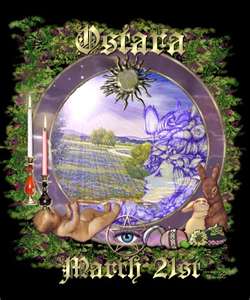
Spring Equinox or Ostara


Pagans and witches celebrate Ostara (also known as Eostre) when the sun enters 0 degrees of Aries, around March 21. In the Northern Hemisphere, the Spring Equinox ushers in warmer weather, days that are longer than nights, and the advent of new life. Christianity adopted this joyful period of the year for the celebration of Easter (which usually falls near the Spring Equinox). Ostara gets its name from the German fertility goddess Ostare; the word Easter derives from the same root. Both holidays celebrate the triumph of life over death.
The Holiday’s Significance
The Sun King’s chariot continues climbing higher in the sky, reaching the point at which day and night are of equal length on Ostara. Therefore, this sabbat is associated with balance, equality, and harmony.
The Spring Equinox marks the first day of spring and the start of the busy planting season in agrarian cultures. Farmers till their fields and sow seeds. Trees begin to bud, spring flowers blossom, and baby animals are born. Ostara, therefore, is one of the fertility holidays and a time for planting seeds—literally or figuratively.
Ways to Celebrate
On Ostara, sow seeds that you want to bear fruit in the coming months. This is an ideal time to launch new career ventures, move to a new home, or begin a new relationship. If you’re a gardener, you’ll start preparing the soil and planting flowers, herbs, and/or vegetables now. Consider the magickal properties of botanicals and choose plants that represent your intentions. Even if you aren’t a gardener, you could plant seeds in a flowerpot to symbolize wishes you hope will grow to fruition in the coming months.
Witches connect each plant—herb, flower, and tree—with specific magickal properties. Sage, for example, is used for purification rituals. Mint and parsley can be added to prosperity talismans to attract wealth. White snapdragons insure protection and roses play an important role in love magick.
Ostara Symbolism
In an old German story, a rabbit laid some sacred eggs and decorated them as a gift for the fertility goddess Ostara. Ostara liked the beautiful eggs so much that she asked the rabbit to share the eggs with everyone throughout the world.
Some popular Easter customs have their roots in Ostara’s symbolism. Eggs represent the promise of new life, and painting them bright colors engages the creative aspect of the sabbat. You might enjoy decorating eggs with magickal symbols, such as pentagrams and spirals. And rabbits, of course, have long been linked with fertility.

Tuesday, March 8, 2011

The Unexpected Perks of Being a Writer

Recently I had the pleasure of editing author Judy Hall’s new book, 101 Power Crystals. Judy is one of the world’s most respected crystal workers and authors, so you may be familiar with her best-selling books, including The Crystal Bible and The Encyclopedia of Crystals. Along the way, Judy mentioned she wanted to acquire specimens of a unique stone known as Llanite and a particular pink-colored granite that she’d seen years ago while visiting the Gulf Coast of Texas. Now Judy lives in England’s beautiful Dorset––but neither of these stones do. As synchonicity would have it, however, both Llanite and Texas Pink can be found in Llano, Texas, about sixty miles from where I live.
For those of you who aren’t familiar with Llanite (and hey, who outside Texas is?), here’s what Judy has to say about it: “With this stone, you truly create your own reality.” Pretty powerful stuff, right? (She discusses it more fully, but you’ll have to get her new book to discover all its properties.)
Immediately I thought: Road trip. So in the name of publishing excellence and disseminating knowledge, I coerced two girlfriends into taking the day off to come rock-hunting with me. On a gorgeous, sunny March day, we drove to lovely Llano in the heart of the Texas Hill Country and like prospectors of old, began our search along the Llano River.

Before long, we’d filled our bucket with dozens of pieces of rose-colored Texas Pink, but alas, no Llanite. So we stopped at a local granite company that specializes in tombstones––ironically called Living Granite––where we were gifted with a chunk of Llanite and a polished slice of Texas Pink. Then we visited Enchanted Rocks and Jewelry, a local gem shop, to have a look around. (Actually, we’d tried twice before, and finally on the third attempt caught proprietor Frank Rowell in residence.) There we found lots of smooth, tumbled pieces of Llanite––even a Llanite lazy susan––along with other assorted crystals, gemstones, and jewelry.
At the end of an altogether delightful day, we came home with a trunk full of rocks and a treasure trove of happy memories, which included meeting lots of friendly and generous people, a private tour of the local nineteenth-century jail conducted by Frank and his friend Steve Roberts, and a delicious lunch of barbecued ribs at Cooper’s. Such are the myriad joys of being a writer! Seek and ye shall find.

Tuesday, March 1, 2011

Authentic Writing


Recently I started writing a novel set in the Jazz Age, 1925. Doing so has required me to get up close and personal with the period––not just familiarizing myself with history-book facts, but also the day-to-day details of ordinary life at that time. What did people wear, eat, read? What jobs did they perform and how did they entertain themselves in their leisure hours? What art did they enjoy, what music did they listen to? How did they travel and communicate with one another? And what words did they use to express themselves?
In a writing class I teach, several of my students are also writing period pieces. One person’s novel is set in the 1600s, another in the mid-1700s, and another in the early 1950s. Each presents the same set of challenges: how to write with authenticity and colorfully depict the era, while avoiding embarrassing goofs. Authentic writing means you don’t make assumptions. You don’t just guess and think your readers won’t realize you’re “all wet” (a Jazz Age term). I can promise you they will. For example, if you’re writing a story set in New England in 1879, don’t show your characters drinking orange juice for breakfast––oranges don’t grow in New England, and transporting them there wasn’t feasible at the time.
Just today, in fact, one of my students read a section from her book, set in the mid-1950s, and mentioned Wal-Mart. The problem is, Wal-Mart didn’t open its doors until 1962. The word “groovy” was another gaff, because as all you old hippies recall, the term became popular during the mid-1960s. But it’s not just amateur authors who make these sorts of mistakes. Stephen King once called a particular type of pistol a revolver when in fact, it wasn’t––and he heard about it from his readers.
So what’s a writer to do? The answer, in a word, is: research. Today, the Internet makes it incredibly easy to gather data of all sorts about any time period that interests you. Want to find out how people washed their clothes in ancient Greece? Or how stained glass windows were made in the Middle Ages? Or how the early American colonists furnished their homes? Google it. It’s all there, anything you want to know.
Here are some other tips:
• Visit museums and historical sites to see what sorts of utensils, clothing, furnishings, tools, etc. people used at different times.
• Read books written during the time period you’re writing about––you’ll learn about social customs and mores, language patterns, political and religious viewpoints, and a whole lot more.
• Peruse old magazines, newspapers, and catalogs. The Sears catalog is a terrific resource. Some of these publications can be found at libraries, others may be available through dealers of vintage literature.
• If possible, interview people who lived during that time. I had the good fortune to talk to a woman who was in her teens during the period in which my novel is set. I was able to ask her intimate details about women’s life at the time, things you won’t find in history books, such as what sort of sanitary materials did menstruating women use then, before the advent of tampons?
Lest you think research is a boring waste of time, I wish to suggest that researching your time period will immerse you more deeply and richly in your story, bring your characters to life, open your eyes to a world you couldn’t possibly have imagined, and inspire you to write better. Honestly, it’s a lot of fun, too. And when you find yourself in one of those “blocked” stages, research is the best way I know to jump-start your creativity.

Sunday, February 6, 2011

Do You Believe in Angels?

We seem to have an innate need to believe in benevolent beings and a mystical realm beyond what we experience in our everyday lives here on earth. For thousands of years, people around the globe, from myriad cultures and belief systems, have sought and received assistance from heavenly helpers. Today, when so much of our world seems baffling, overwhelming, or totally out of control, perhaps it’s no coincidence that angels seem to be showing up in large numbers to guide us on life’s perilous journey.
In 2008, the Washington Post conducted a poll of 36,000 adults from various religious and nonreligious backgrounds. It found that most Americans think angels actively participate in our lives, and more than 80 percent believe miracles occur.


Angels, it seems, can and do appear to all sorts of people––even nonbelievers. In fact, they may be present in our lives all the time, holding our hands, watching our backs, and whispering in our ears. If F. Forrester Church, author of Entertaining Angels, is right, “Every moment of every day is riddled by their traces.”

In my forthcoming book, The Angels Among Us, nearly 100 people contributed stories of their personal experiences with angels. Not only that, they took astonishing and beautiful photographs of the angels, which are included in my book. Seeing angels, they say, strengthened their faith––and in some cases changed their lives forever.

Thousands of people around the world have photographed what they think are angels––the website www.angelsghosts.com is a great place to see lots of amazing and thought-provoking pictures. Countless other people say they’ve experienced angelic contacts of some kind. You, too, may have encountered an angel, you just didn’t realize it at the time. Perhaps an angel is hovering beside you at this very moment. (Excerpted from my book The Angels Among Us, soon to be published by David & Charles Publishers, Ltd.)

Monday, January 3, 2011

Meditate for Health and Happiness

While you’re making New Year’s resolutions, you may want to consider adding daily meditation to your to-do list. Meditation could be the single best thing you can do for yourself. It’s easy and pleasant, anyone can do it, and it’s absolutely free. During the last four decades, more than 600 studies conducted at 250 universities and medical schools worldwide have verified meditation’s efficacy. More than 350 scientific and medical journals have published research showing the benefits of meditation for conditions including diabetes, coronary disease, cancer, chronic pain, and more. You’ll see positive results even if you just ten minutes a day.


This spring, my new book “The Best Meditations on the Planet” co-authored with Dr. Martin Hart, will be published by Fair Winds Press/Quayside Publishing Group. In it you’ll find 100 mediations of various types for relaxation, physical and emotional healing, enhancing success, improving intelligence and creativity, longevity, and lots more––something for everyone. The meditation given below isn’t included in the book, but you can try it yourself if you like––and check out the wonderful quartz crystal bowls from Crystal Tones, too.
Play a Singing Bowl to Soothe Stress
You’ve heard the saying “music soothes the savage beast,” and indeed, research indicates that listening to certain sounds can encourage relaxation and promote healing. As Mitchell Gaynor, M.D. explains in his book Sounds of Healing, "Music can have a powerful salutary effect on our cardio-vascular, immune, and nervous systems, not to mention our emotional
and spiritual selves." So it’s no surprise that many people find music or musical tones, such as those produced by singing bowls, increase the benefits of meditation.

In the East, singing bowls are a traditional tool used by monks to deepen meditation and induce healing. Singing bowls reduce stress by letting us “tune” ourselves, bringing our personal energies into balance. Usually made of metal or crystal, these bowls can be struck with a soft mallet to produce a ringing tone, like a bell. When you rub the mallet around the bowl’s lip, the bowl’s “voice” opens and it sings a harmonic chord.
  1. Set a singing bowl on a firm cushion or folded towel. Your bowl may come with a rubber ring on which to position it securely.
  2. Stand or sit facing the bowl. Position yourself so you feel comfortable.
  3. Take a few slow, deep breaths and begin to relax.
  4. With a soft mallet, gently strike the rim or side of the bowl to produce a ringing sound, like a chime.
  5. Focus your attention on the pleasing sound. Listen to it reverberate, and gradually fade away.
  6. Strike the bowl again and feel the sound waves vibrating in your body. You may notice the resonance is stronger in one particular section of your body.
  7. Slowly run the mallet around the rim of the bowl to make it “sing.”
  8. As you continue circling the rim of the bowl with the mallet, focus on how the singing grows louder and clearer.
  9. Allow the waves of sound to wash over you and through you, dissolving the stress from your mind and body.
  10. Circle the rim of the bowl until it sings, then strike the side of the bowl so the two sounds reverberate together. Listen to their harmonious interaction.
  11. Feel the soothing sounds resonate through your body––not just your ears, but your head, heart, solar plexus, all the way down to your feet––gently melting your stress.
  12. If you wish, you can lie down and place the bowl on a part of your body, such as your chest or abdomen, where tension seems greatest. Strike the bowl and feel the sound waves ripple through you, easing stress.
  13. Continue playing the singing bowl for as long as you like.
Play your singing bowl as often as you wish, whenever you feel a need to soothe stress and restore balance to your body, mind, and spirit. Singing bowls come in various sizes, tuned to different notes on the musical scale. Each note produces a unique resonance that harmonizes with a particular energy center (or chakra) in your body. You may wish to play two or more bowls in combination to reduce stress in various parts of your body.

Sunday, October 24, 2010

The Secret of Abundance

“Be content with what you have;
Rejoice in the way things are.
When you realize there is nothing lacking,
The whole world belongs to you.” – Lao Tzu
This quote seems to sum up the secret of abundance, in the simple and elegant way of Eastern mysticism and philosophy. Those of you who are familiar with the Law of Attraction know you attract whatever you think about. When you focus on the blessings in your life, you attract more blessings. But when you constantly worry about what you lack, you’ll create more lack. Easier said than done, I know, but true.

The great sage reminds us that the universe offers unlimited bounty and joy––it lacks nothing. All we have to do is open our eyes to it. By appreciating the goodness you already have, you tune your personal resonance to a vibration of acceptance and receptivity. From this place, all things become possible.
I find making “vision cards” like the one shown here helps me focus. I use these cards as meditation/visualization tools to attract whatever I desire. Vision boards overwhelm me with too many ideas and images––the small scale of a single card (4” X 6”) also enables me to carry the card with me. You may want to try it to see if it works for you, too.